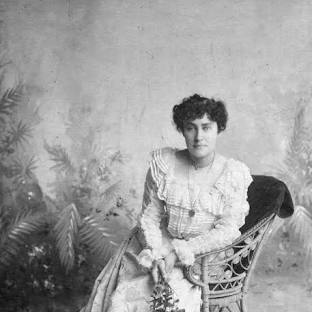
E. Pauline Johnson: Canadian Performance Poet
My heart forgot its God for love of you,
And you forgot me, other loves to learn;
Now through a wilderness of thorn and rue
Back to my God I turn.
And just because my God forgets the past,
And in forgetting does not ask to know
Why I once left His arms for yours, at last
Back to my God I go
–A Prodigal, E. Pauline Johnson
E. Pauline Johnson was an Anglo-Mohawk poet-performer whose poetry is still read in Canadian schools today. Born in 1861 on a reservation in Western Canada, she is the daughter of English woman and Mohawk chief George Henry Johnson. Her multicultural upbringing of both English and Native traditions gives her work an incredibly unique perspective, both through her lens and the lens of the reader. Her writing on her experience as both the colonized and the colonizer lends us a particular view into colonial writing that few others have been able to give us. Despite being one of the most well-known poets in Canada at the time, her legacy outside of Canada is little known.
Johnson’s childhood home was often host to many diplomats and dignitaries, as her family was part of the local aristocracy.1 Her relationship with her racial and cultural background is the driving force in her work, as she seemingly tries to give white audiences a view into the Mohawk culture that dispels the idea of “savagery.” She began writing to support herself after the death of her father in 1884, and published under two names: E. Pauline Johnson and her stage name Tekahionwake (her grandfather’s name)2, signaling her identity as both a white and Mohawk woman. Her multicultural background is something that Johnson never shied from, instead embracing both identities. While writing poetry and prose, she found the most success in performing poetry across Canada and America, which she would do from 1892 to 1909. While her poetry was undeniably well written, it was the performance aspect that seemed to fascinate audiences. At the beginning of her set, she wore traditional Native dress for her performances of poetry that dealt with Native subjects.3 Then for the second half of the set, she would appear in an evening dress. This changing of garb has been noted by postcolonial scholars as a way for her to give “audiences the thrill of savagery,”4 and then reintroduce a sense of “sophistication” so to speak.
Johnson passed away in 1913 from breast cancer5 Johnson’s life as a performance poet was incredibly rich, as she wrote about the complexities of being a Native person in a colonial setting, but also for her performance style. Johnson was known globally for her performance poetry, and her poem “The Song My Paddle Sings” is still read and recited in Canadian schools today.6 She is the author of 165 poems, and multiple short stories, remembered as a prolific indigenous woman writer whose influences on postcolonial studies and performance poetry are indubitable.
My Thoughts:
E. Pauline Johnson is an absolutely fascinating literary figure who deserves significantly more recognition than she currently has. What makes her so interesting to study is her use of both of her cultures to express herself and her relationships with her identity. Specifically in her use of wardrobe in her performances. The idea that she had to cater to a white audience (of which she was also apart of) through Native dress as a way to show them a “savagery” that they expected out of a Native performer is both sickening, but also incredibly intelligent. By showing both the “Indian” and “White” side of her, she is confronting the audience with their own assumptions about what a native woman should be.
There are so many different ways to dissect Johnson’s poetry and performance style that occupy multiple sects of literary theory that it would be difficult for me to touch on them all in this rather short biography, but what is important to me in this project is that we just begin to recognize Johnson and all that she wrote about. From the perspective of someone who studies literature, her life and poetry are filled with both beautiful writing and such incredible opportunities to learn about native life that it is almost dumbfounding that she is not more well known.
Bibliography
GERSON, CAROLE. “Postcolonialism Meets Book History: Pauline Johnson and Imperial London.” In Home-Work: Postcolonialism, Pedagogy, and Canadian Literature, edited by Cynthia Sugars, 423–40. University of Ottawa Press, 2004. https://doi.org/10.2307/j.ctt1ckpc18.27.
Jones, Manina, and Neal Ferris. 2017. “Flint, Feather, and Other Material Selves: Negotiating the Performance Poetics of E. Pauline Johnson.” American Indian Quarterly 41 (2): 125–57. https://search-ebscohost-com.libproxy.scu.edu/login.aspx?direct=true&db=rfh&AN=ATLAiB8W170911002168&site=eds-live.
NEIGH, JANET. “E. Pauline Johnson (Tekahionwake) and Her ‘Dear Dead Longfellow.’” In Recalling Recitation in the Americas: Borderless Curriculum, Performance Poetry, and Reading, 28–60. University of Toronto Press, 2017. http://www.jstor.org/stable/10.3138/j.ctv1n3596q.5.
Robinson, Amanda. “Pauline Johnson (Tekahionwake).” The Canadian Encyclopedia. Historica Canada. Article published April 14, 2008; Last Edited January 24, 2020
- Manina Jones, and Neal Ferris. “Flint, Feather, and Other Material Selves: Negotiating the Performance Poetics of E. Pauline Johnson.” American Indian Quarterly 41, no. 2 (2017): 125–57. https://doi.org/10.5250/amerindiquar.41.2.0125. ↩︎
- Jones and Ferris. “Flint, Feather, and Other Material Selves”
↩︎ - GERSON, CAROLE. “Postcolonialism Meets Book History: Pauline Johnson and Imperial London.” In Home-Work: Postcolonialism, Pedagogy, and Canadian Literature, edited by Cynthia Sugars, 423–40. University of Ottawa Press, 2004. https://doi.org/10.2307/j.ctt1ckpc18.27. ↩︎
- GERSON, CAROLE. “Postcolonialism Meets Book History”
↩︎ - Jones and Ferris. “Flint, Feather, and Other Material Selves”
↩︎ - NEIGH, JANET. “E. Pauline Johnson (Tekahionwake) and Her ‘Dear Dead Longfellow.’” In Recalling Recitation in the Americas: Borderless Curriculum, Performance Poetry, and Reading, 28–60. University of Toronto Press, 2017. http://www.jstor.org/stable/10.3138/j.ctv1n3596q.5.
↩︎
 The Underrepresented Modernism Project.