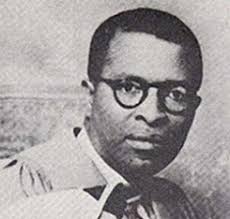
Benedict Wallet Vilakazi: The King of Zulu Poetry
Ngikhumbule kud’ ekhaya I remember far away at home
Laph’ ilanga liphumela There where the sun comes up
Phezu kwezintab’ ezinde Above the tall hills
Lishone libomv’ enzansi And goes down shining red below
Kuze kusondel’ ukuhlwa Until dusk comes
Nokuthul’ okucwebile, With its pure silence
Laph’ uphuma phandl’ unuke, There where you go outside and breathe in,
Uhogele ngamakhala, Breathe in deeply with full nostrils
Uzigqum’ umzimba wonke And feel your whole body affected by
Ngomoya wolwandl’ omanzi. The moist air of the sea.
-Benedict Wallet Vilakazi
Hailed as one of the greats of African Literature and hardly known to the Western canon, Benedict Wallet Vilakazi was a South African poet and scholar whose work transcended the Zulu Language. During his short life of 41 years, he published three important novels and two anthologies of poetry,1 as well as becoming the first black professor to teach white students in South Africa. This is just a glimpse into his work and his life, both of which have greatly influenced African literature and poetry.2
Benedict Wallet Vilakazi was born in 1906 in Groutville Mission Station, South Africa. He was the fifth of six children and spent his childhood herding cattle. Despite obtaining a doctorate later in life, he barely attended school during his childhood. His parents were both Christian, and Vilakazi would eventually attend St. Francis College. In 1923, he began teaching at a local college and would bounce around multiple institutions. It was not until the 1930s that he began to publish his poetry, and began working with Zulu language scholar, John L. Dube.
Unlike some African writers, Vilakazi chose to write his creative works exclusively in his mother tongue, Zulu. While his scholarly works were written in English, is his allegiance to the Zulu language that shines in his work. His poetry is unapologetically African, “His body of work offers salient perspectives on the meanings and location of African languages and literature with regard to epistemic diversity, the “transformation” of curricula, tradition versus modernity, gender, the meaning of identity, and the broader humanist project, even though accounting for all of these issues will not be possible.”3 As well as transforming the use of African language, his themes have held up over the test of time. While an unfortunate reality of the world we live in, the struggles of black people have remained similar, even one hundred years later. Nilakazi wrote many poems dealing with the safety of South Africans in mines, a problem that is still facing miners today.4 As well as facing the problems of the everyday black person, Vilikazi also used traditional African religious imagery and royal figures in his poems.5 Vilikazi was unequivocally an African writer, who incorporated his vast knowledge of the Zulu language and South African culture into his writing, in a way that is still relevant today.
On October 26, 1947, Benedict Wallet Vilakzi met his untimely demise after contracting meningitis. Despite his rather short life, Vilikazi was able to accomplish an extraordinary feat by any writer’s standards. A giant of both poetry and scholarship, his passion for the Zulu language and the struggles of South Africans continue to influence scholars today. Despite little recognition in the West, it is undeniable that Vilikazi is a literary great.
The case for Benedict Vilakazi as a Modernist
It seems rather obvious to me that Benedict Wallet Vilakazi should be classified as a modernist. As has been already established, he completely transformed the use of his mother tongue and was one of the pioneers of African Literature. His writings on the struggles of the everyday person, his expectations with language, and his writings on race, in my opinion, make him a clear modernist writer. Despite his clear literary merits, Western scholars have all but ignored or forgotten Vilakazi and his poetry. Writer and scholar Nkosinathi Sithole finds it “(…) disturbing that the publication of Chinua Achebe’s Things Fall Apart in 1958 is said to have marked the birth of African literature, while there were many books published in Africa before 1958.”6 This presents me with the question: If Vilakazi is so important in the African canon of literature, why is he so under-studied in Western scholarship? Upon researching, a few answers presented themselves.
To begin, Vilakazi exclusively wrote his creative work in Zulu. Sithole notes in an article about Vilakazi that African writers who wrote in Western languages have been more likely to be read and picked up by Western people. While at the time of publication, translations of his work may have been hard to locate, it would make sense that Western readers would have been unfamiliar with his work. While this explains why Western readers of Zilakzi’s time may have been unfamiliar with his work, the question remains as to why more people of today’s age are unfamiliar with his work. His writing now has been translated into over 50 languages, making it largely more accessible to modern readers.7 It is then the sadly probable case that the prejudice and bias in the literary community that Benedict Wallet Vilakazi was left behind. He is so clearly a South African writer, it is the topic and language of his writing. I do not pretend to be an expert or well-versed in African Literature, a term that encompasses many cultures and subsets of different literatures. Despite considering myself to be a reader who enjoys books and writing from all over the world, African literature is not something that I have been introduced to in both my academic and personal life. I wager the argument that many scholars chose to separate African Literature from what they are familiar with, othering the work to keep it away from the Western canon. This topic is complicated and contains thousands of years of history, and I do not pretend to know it all. I do however believe that it is a loss of Western scholars to ignore the greatness and influence of African literature. It was clear to me after reading just a few articles that Vilakazi is a monumental and important figure in the South African literary tradition. It is my hope that after reading my summary of his work and life you will come to understand his greatness as well.
To view his work, follow this link.
Bibliography
“Benedict Vilakazi – a Short Biography and Bibliography – of This KwaZulu-Natal Author.” Benedict Vilakazi, 2012. https://web.archive.org/web/20050307222515/http://literature.kzn.org.za/lit/25.xml.
Malcolm, D. Mck. “Introduction,” translated by Florence Louie Friedman. In Vilakazi, Benedict Wallet, Zulu Horizons, xiii-xv. Witwatersrand University Press, 1973. Quoted in Twentieth-Century Literary Criticism, edited by Paula Kepos. Vol. 37. Detroit, MI: Gale, 1991. Gale Literature Criticism (accessed September 8, 2024). https://link-gale-com.libproxy.scu.edu/apps/doc/HYDMUN161905732/GLS?u=sant38536&sid=bookmark-GLS&xid=3fb61ff3.
Sithole, Nkosinathi. 2021. “Resituating ‘African-Language’ Literatures in African Literature: The Case of BW Vilakazi.” South African Journal of African Languages/Suid-Afrikaanse Tydskrif Vir Afrikatale 41 (2): 222–29. doi:10.1080/02572117.2021.1948228.
Zondi, Nompumelelo Bernadette. 2020. “Resurrecting the ‘Black Archives’: Revisiting Benedict Wallet Vilakazi With a Focus on the Utility and Meaning of African Languages and Literatures in Higher Education”. Education As Change 24 (April):20 pages. https://doi.org/10.25159/1947-9417/4626.
.
- Zondi, Nompumelelo Bernadette. 2020. “Resurrecting the ‘Black Archives’: Revisiting Benedict Wallet Vilakazi With a Focus on the Utility and Meaning of African Languages and Literatures in Higher Education”. Education As Change 24 (April):20 pages. https://doi.org/10.25159/1947-9417/4626. (12)
↩︎ - “Benedict Vilakazi – a Short Biography and Bibliography – of This KwaZulu-Natal Author.” Benedict Vilakazi, 2012. https://web.archive.org/web/20050307222515/http://literature.kzn.org.za/lit/25.xml.
↩︎ - Zondi, Resurrecting the “Black Archives”
↩︎ - Zondi, Resurrecting the ‘Black Archives (4)
↩︎ - Zondi, Resurrecting the ‘Black Archives (4)
↩︎ - Sithole, Nkosinathi. 2021. “Resituating ‘African-Language’ Literatures in African Literature: The Case of BW Vilakazi.” South African Journal of African Languages/Suid-Afrikaanse Tydskrif Vir Afrikatale 41 (2): 222–29. doi:10.1080/02572117.2021.1948228.
↩︎ - Sithole, The Case of BW Vilakazi (223)
↩︎
 The Underrepresented Modernism Project.
